Articles
The Paper Ceiling: Why Investing Remains Elusive for African Women
“Put your head down and work hard” is the worst advice I’ve ever gotten. If hard work is what it took to succeed, every woman in the global majority would be financially secure.
During the pandemic, I started educating myself on personal finance. It was already obvious to me that hard work and saving money are not enough to achieve financial security. Financial literacy seemed daunting but I persevered. In time, I learned about investing from women who were taking charge of their finances and growing their money. I was going to join them. It’s been years now, I still don’t have any investment. Not for lack of trying. The Paper Ceiling is in the way. Investment platforms ask for verification, documents and paperwork that I cannot provide due to various reasons that are out of my control.
While the Glass Ceiling is about visibility and social prejudice, the Paper Ceiling is about bureaucratic and systemic exclusion. I keep hitting my head on an invisible ceiling. I knew the glass ceiling, intimately. This was different. The Paper Ceiling is made of paperwork, reinforced by bureaucracy and barriers. I wondered about the many African women, who like me, had dreams of a better life…only to join me among the casualties.
It highlights that even if a woman is highly skilled or has a viable business, the lack of specific, formal documentation (which the system is designed to make difficult for her to obtain) acts as a hard stop to her economic growth.
Investing is rarely a simple matter of choosing between a savings account and a stock index. For the majority of African women, the decision to grow wealth is a trek across a landscape littered with historical and structural fences. While financial gurus often preach about the magic of compound interest, they frequently ignore the reality that you cannot compound what you are not allowed to own.
I knew the glass ceiling, intimately. This is different. The Paper Ceiling is made of paperwork, reinforced by bureaucracy and barriers. I wondered about the many African women, who like me, had dreams of a better life…only to join me among the casualties.
The first and most formidable fence is the ownership gap. In many societies, land is the ultimate currency of stability. Yet, through a combination of traditional customs and rigid legal hurdles, women are often blocked from owning or inheriting the very soil they till (Doss et al., 2018). This has a cascading effect. When a bank asks for collateral to back an investment loan, it usually wants a land title. Without that piece of paper, a woman’s financial ambition is grounded before it can take flight. She is effectively locked out of the formal credit markets that her male counterparts use as a ladder (African Development Bank, 2021).
Then there is the silent, exhausting tax of the care economy. Time is the most precious asset for any investor, but for African women, time is a scarce resource. They are the primary shock absorbers for society. They manage households, raise children, and care for the elderly. This unpaid labor is the invisible glue holding communities together, but it leaves very little room for the deep work of financial planning (International Labour Organization, 2018). When your day is consumed by the immediate survival and care of others, the luxury of researching market trends or attending networking events feels like a world away.
Even for those who manage to break through to the entrepreneurial stage, the gatekeepers of capital remain skeptical. We are currently seeing a massive tech boom across the continent, yet the venture capital flowing into these hubs is strikingly one sided. Female-led ventures receive a tiny fraction of total funding; often cited as less than 3% of the total capital deployed in the ecosystem (Babatunde & Madica, 2023). This is not due to a lack of viable ideas. It is often the result of an institutional bias that views women’s calculated, risk-aware strategies as a lack of "scale" or "disruption." This forced exclusion pushes women toward informal savings groups. While these groups are masterpieces of community resilience, they rarely offer the massive capital infusion needed to enter high-growth global markets.
The language of finance itself often acts as a gatekeeper. The world of investing is frequently wrapped in a thick layer of jargon designed to make the simple sound complex. For women who have been historically pushed to the margins of formal education, this vocabulary can feel like a "keep out" sign. Furthermore, most financial products are not built for the actual lives women lead. They often require high minimum deposits or follow rigid payment schedules that do not account for the fluctuating income of the informal sector, where so many women operate (UN Women, 2023).
Finally, we must look at the legal hurdles that still linger in the shadows. In some places, a woman might still encounter the absurdity of needing a male relative’s permission to open a bank account or sign a contract (World Bank, 2022). Even where the laws have changed, the bureaucracy remains slow and expensive to navigate. This lack of clear legal protection makes a woman’s hard-earned wealth vulnerable.
True inclusion requires more than just a few financial literacy workshops. It requires a fundamental redesign of the systems that dictate who gets to own, who gets to lead, and who gets to grow (Nawi Afrifem Collective, 2024). When we dismantle these barriers, we aren't just helping women. We are unlocking a massive, untapped engine of economic power that has the potential to transform the entire continent. In the meantime, I continue my journey to figure out how to tear down the Paper Ceiling.
References
African Development Bank. (2021). Africa’s gender gap in access to finance. African Development Bank Group.
Babatunde, O., & Madica. (2023). Diversity dividend: Exploring gender equality in the African tech ecosystem. Disrupt Africa. https://disrupt-africa.com/2023/06/diversity-dividend-report/
Doss, C., Meinzen-Dick, R., Quisumbing, A., & Theis, S. (2018). Women in agriculture: Four myths. Global Food Security, 16, 69–74. https://doi.org/10.1016/j.gfs.2017.10.001
International Labour Organization. (2018). Care work and care jobs for the future of decent work. ILO Publishing. https://www.ilo.org/publications/major-publications/care-work-and-care-jobs-future-decent-work
Nawi Afrifem Collective. (2024). Feminist political economy and the digital divide on the African continent. Nawi Collective Resources.
UN Women. (2023). Progress on the Sustainable Development Goals: The gender snapshot 2023. UN Women and United Nations Department of Economic and Social Affairs. https://unstats.un.org/sdgs/gender-snapshot/2023/
World Bank. (2022). Women, Business and the Law 2022. World Bank Publications. https://openknowledge.worldbank.org/handle/10986/36945
Night Owl Productivity: How To Thrive As A Nocturnal Professional
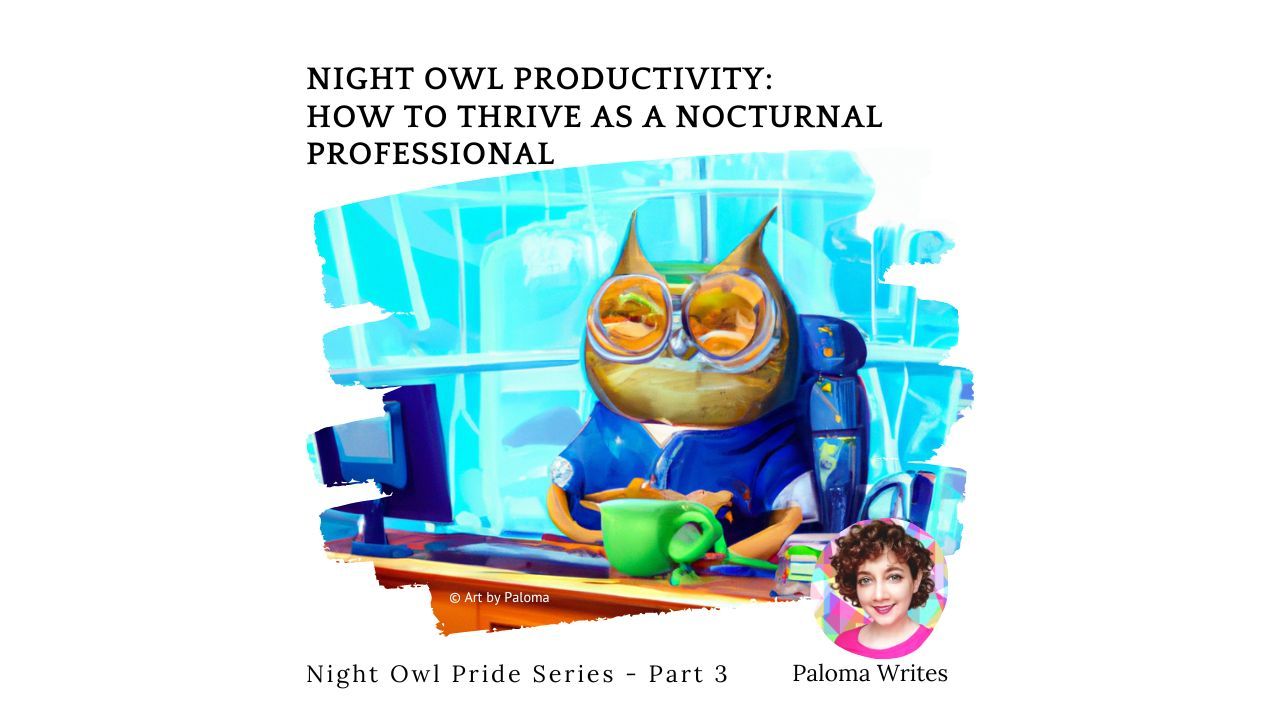
Night Owl Pride Series - Part 3
Do you have trouble dragging yourself out of bed in the morning and find yourself more alert and creative at night? Are you one of those nocturnal creatures known as night owls? Welcome to the club.
In Part 1, I talked about radical acceptance of my nocturnal chronotype, which means being a night owl.
In Part 2, I talked about the science of chronotypes and working with our natural rhythms.
In part 3, I want to talk about the intricacies of being a night owl and productivity at the office.
As a night owl, I know firsthand the struggle of adjusting to a standard 9-to-5 work schedule designed for early birds. Working the night shift for a decade did not work for me either.
Since 2021, I made the switch to full-time freelancing. Most of my struggles as a nocturnal animal have magically disappeared since then. I recognize that making this switch is a privilege. Most of my friends are still working in corporate offices, where they have to clock in and clock out according to fixed hours.
I’ve compiled a list of accommodations that would have made a huge difference in my office life. While most of my writing is drawn from my lived experience, this one is about wishful thinking.
What would have kept me happy and productive at the office with regard to my chronotype?
Flexible Work Schedule
This one's a no-brainer. Allowing for a flexible work schedule can be a game-changer for night owls. Instead of requiring us to work traditional hours, we could be allowed to start our workday later in the morning or early afternoon and work into the evening or night. This flexibility can help us maintain a consistent sleep schedule and prevent burnout.
Work from Home
As much as we love our coworkers, sometimes we just need some alone time to get things done. And for night owls, working from home can be the perfect solution. The morning commute can be a nightmare for anyone, but for night owls, it’s a special kind of hell. Offering the option to work from home can be a huge benefit for us. It eliminates the need to commute during rush hour, which can add to our stress, thus disrupting our sleep schedule. Even morning people will agree with this one.
Adjustable Lighting
Bright fluorescent lighting can be a real shock to our systems. It’s a sensory nightmare for me. Since night owls may have difficulty waking up early in the morning, dimmer lighting can be used in the morning to simulate sunrise and help us wake up gradually. Brighter lighting can be used in the evening to help us stay alert and focused. Plus, dim lighting is just more flattering.
Designated Quiet Spaces
Quiet spaces can be a valuable resource for night owls who need to rest during the day. These rooms can be equipped with comfortable seating, pillows, and blankets to help us get the rest we need. I’m not a napper but I benefit from non-sleep deep rest (NSDR). I learned the term from Dr Andrew Huberman.
Meetings
We night owls can feel like we’re living on a different planet than our early bird colleagues. Meetings that are scheduled later in the day can help us feel included.
What about working a night shift job?
It seems like a logical solution. I did it for a decade and decided it was not for me. Therefore, it’s up to the individual. Making my own hours is really the best solution for me. However, I can only speak for myself because night owls are not a monolith.
Working night shifts can have negative effects on both physical and mental health. Studies have shown that night shift workers are at a higher risk of developing chronic conditions such as obesity, diabetes, cardiovascular disease, and cancer. This is thought to be due to the disruption of the body's natural circadian rhythm, which can affect metabolic processes, hormone levels, and immune function. Night shift workers are more likely to experience sleep disturbances, fatigue, and mental health problems such as depression and anxiety.
A study published in 2021 found that healthcare workers who worked night shifts during the COVID-19 pandemic were at a higher risk of developing symptoms of anxiety and depression compared to those who worked day shifts.
Radical Self-Acceptance
Fellow night owls, we may have been born under a different star. We may have moonlight written in our genes. But fear not, for we are not alone in our nocturnal ways. We are part of a club that is just as exclusive as it is misunderstood. I’ve accepted my fate as a creature of the night, embracing my inner owl with open wings. I wish the same for you.
Looking for an experienced content writer? I translate your vision into impactful words. Let’s work together!
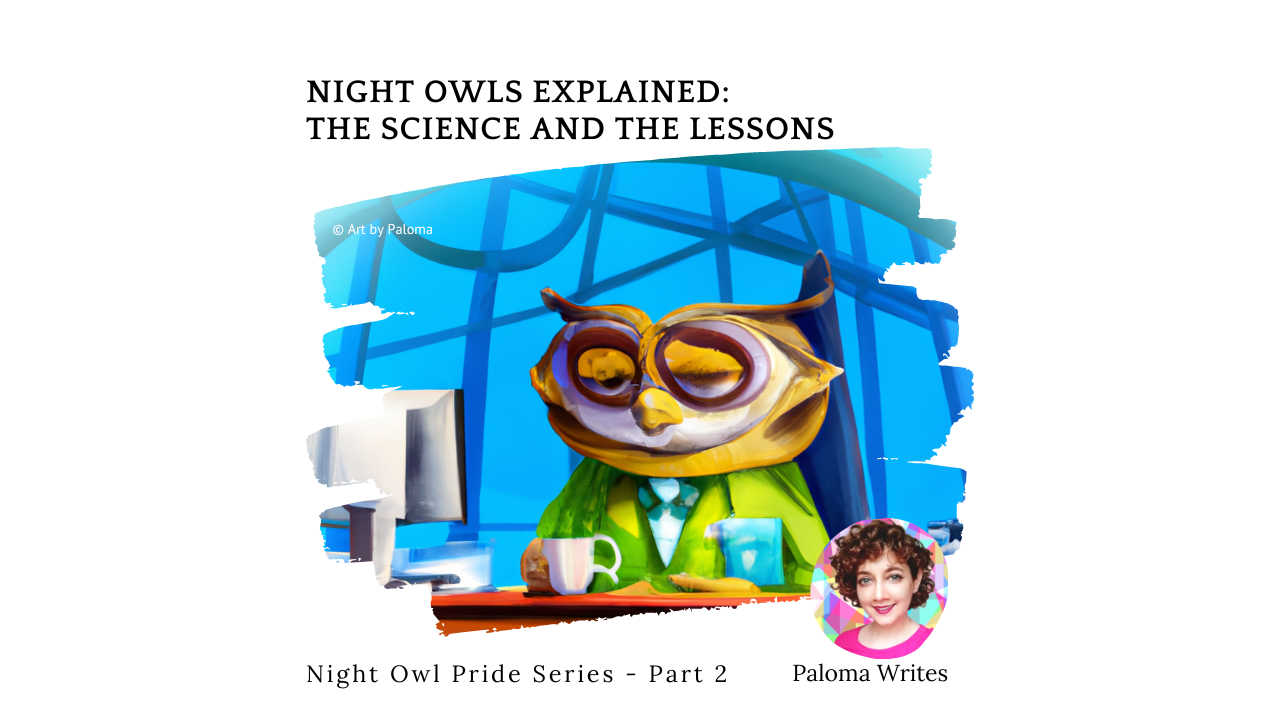
Night Owls Explained: The Science and the Lessons - Part 2
Art By Paloma
Art By Paloma
Night Owl Pride Series - Part 2
Sick of being called lazy just because you prefer to hit the snooze button until noon? Well, my fellow night owls, it's time to break the stigma and embrace our nocturnal nature. Because guess what? We're not just lazy, we're just genetically wired that way.
First off, let's define what we're dealing with here. A nocturnal chronotype is a fancy way of saying that you're a night owl. It’s the type of person who prefers to stay up late and sleep in until the sun is high in the sky. As a night owl who is a writer, poet, and artist, I do my best creative work from sunset onwards. If this sounds like you, congratulations, you're part of an elite group of people who have been bestowed with some pretty sweet evolutionary advantages.
Sleep patterns are deeply ingrained in our biology, and many people fall into the category of night owls or nocturnal chronotypes. While society tends to favor early risers, there is mounting evidence that these night owls are not simply lazy or undisciplined, but rather an evolutionary necessity. It makes little evolutionary sense that absolutely all humans would go to bed and wake up at the same time. Back in ancient days, some of us had to tend to fire and guard the village at night.
So grab a cup of coffee (or three) and let's dive into the undeniable benefits of being a night owl.
1. One of the most significant benefits of being a night owl is increased creativity. In a study published in the journal Thinking Skills and Creativity, researchers found that participants who identified as night owls performed significantly better on creativity tests than those who identified as morning people.
2. Another benefit of being a night owl is improved cognitive performance at night. Research published in the journal Frontiers in Human Neuroscience found that night owls had better cognitive performance and attentional control during the evening hours than morning people. This may be due to the fact that night owls' internal clocks are aligned with the natural fluctuations of the environment during those hours, allowing them to be more alert and focused.
3. Research published in the journal Sleep Medicine Reviews found that being a night owl may actually be a sign of greater genetic diversity. Night owls have been found to have a wider range of genetic variations associated with circadian rhythms, suggesting that they may be more adaptable and better suited to changing environments.
Whether you are team morning or team evening, I believe it is possible for us to accept and accommodate each other’s chronotypes. Some of my best friends are morning people. One of them said I taught her a valuable lesson in acceptance since I started unapologetically accepting my natural rhythm. I don’t call her at 1 am to discuss spiritual breakthroughs. She doesn’t invite me for breakfast at 8 am. We meet for an early dinner. Problem solved!
-Paloma Writes
#chronotype #nightowl #workplaceculture #inclusion #selfawareness #contentwriter
Looking for an experienced content writer? I translate your vision into impactful words. Let’s work together!
Night Owl Pride: How to Find Self-Acceptance in a Morning-Oriented World - Part 1
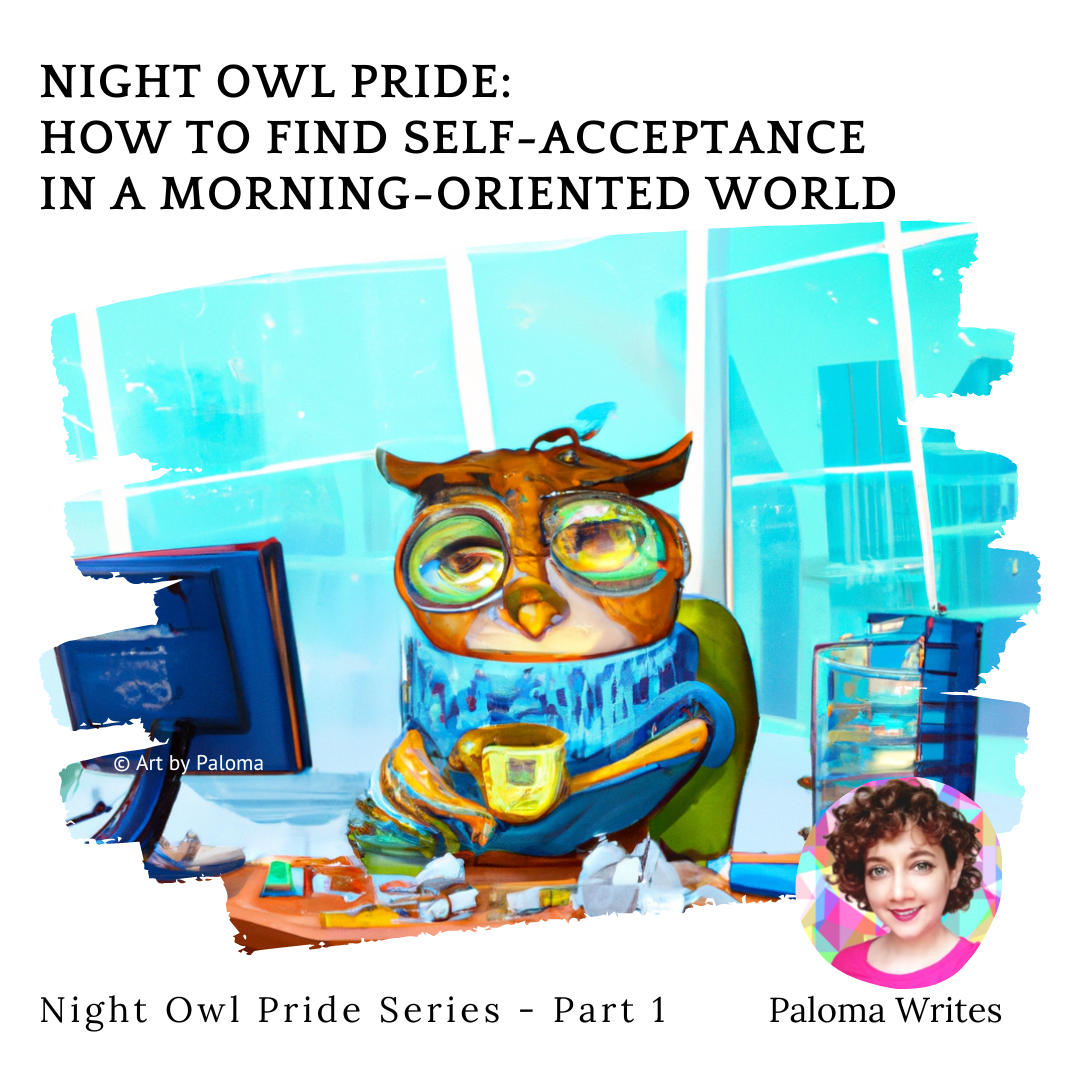
I am Paloma. I’m a night owl and proud of it. After a lifetime of trying to turn into a morning person, I decided to work with my natural rhythm rather than fighting against it. I’m now in radical acceptance of my natural chronotype.
A chronotype is one’s natural inclination towards staying up late or waking up early. It’s like your own internal clock that dictates when you feel most alert and productive.
If you're nocturnal like me, you may have noticed that you feel more energized at night than during the day. This is because your internal biological clock is set to later hours than that of early risers. In other words, you have a delayed sleep-wake phase. There’s nothing wrong with that. It’s genetic. Yet, night owls often face negative attitudes and stereotypes, especially in a society that values early risers and morning productivity.
I am often shamed for not being a morning person. The first step I took toward self-acceptance is to stop shaming myself. Here are some examples and suggestions for how to respond when being shamed by others.
1. Being called lazy or unmotivated: Morning people often assume that night owls are sleeping in and wasting the day. However, research has shown that night owls may be just as productive as morning people, but at different times of the day.
How to respond: Point out that productivity and creativity are not limited to morning hours, and that different people have different natural rhythms. You might also suggest that you would be more productive and efficient if you were allowed to work during your peak hours.
2. Being shamed for not trying hard enough: I’m often told to "just go to bed earlier". I’ve received this advice over and over from my well-meaning morning-person friends. Others (who are not so well-meaning) have told me that I lack discipline and determination. Research has shown that chronotype is largely determined by genetics and not easily changed (Jones et al., 2020). I stopped trying to change something that’s determined by genetics.
How to respond: Explain that your sleep patterns are largely beyond your control and that trying to force yourself to sleep earlier is likely to be counterproductive. It’s like telling a morning person to try staying up until later than their bedtime.
3. Being shamed for skipping morning social events: Many social and professional events are scheduled for early in the morning, which can be difficult for night owls. This can lead to feelings of isolation and exclusion, as well as missed opportunities. I normally say no to 8 am breakfast meetings, or sunrise beach walks.
How to respond: Explain that your natural sleep patterns make it difficult to attend early-morning events, and suggest alternative times that would work better for you. You might also point out that accommodating different chronotypes can lead to better outcomes for everyone involved. I tell my friends that it’s totally okay if they go to a morning meetup without me because I accept and support their chronotypes unconditionally. I did have some FOMO (fear of missing out) before but not so much anymore.
How do you find out your chronotype? One way is to take a chronotype test, which can provide you with insight into your sleep patterns and energy levels throughout the day.
Whether you’re a night owl or a morning lark, it’s important to honor your natural rhythm.
So which one are you? What are the things you struggle with when it comes to your chronotype?
Source:
Jones, S. E., van Hees, V. T., Mazzotti, D. R., & Dashti, H. S. (2020). Genetic studies of accelerometer-based sleep measures yield new insights into human sleep behaviour. Nature Communications, 11(1), 1-10.
Women Supporting Women: 10 Strategies to Tackle Workplace Sexism
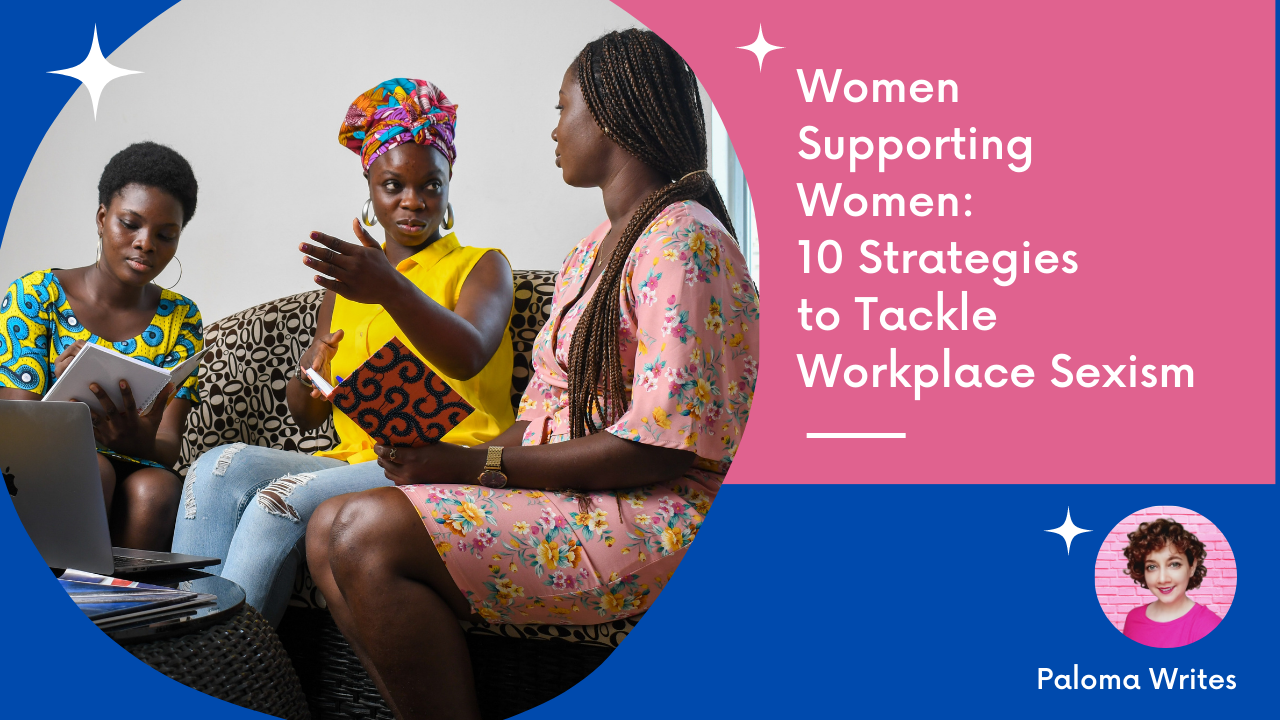
Despite tremendous progress in the last few years, sexist micro-aggressions are still rampant in the workplace. As an ally to other women, there are specific tactics I use to support them. Drawing from my lived experience, I’ve compiled 10 ways women* can help each other tackle workplace sexism:
1. Amplify each other's voices: Women amplify each other's ideas and contributions during work meetings, giving credit where it is due. For example, when I see a woman colleague being interrupted and talked over, I speak up and say: “It would be great if we could allow [Mariam] to finish was she was saying.”
2. Challenge sexist comments and behaviors
3. Mentor and sponsor other women: Women can mentor and sponsor other women, providing guidance, support, and opportunities for advancement. Even if I was not in a leadership position, I volunteered to mentor and guide my peers. For example, when a new member joined my team, I reached out to show them the ropes and kept an open channel of communication if they needed any help.
4. Form support groups: Women can create support groups to share experiences, offer advice and encouragement, and provide a sense of community and solidarity. For example, I set up a LeanIn circle and other less formal support groups.
5. Share resources and opportunities: Women can share job openings, networking events, and training opportunities with each other, increasing access and opportunities for professional growth. For example, knowing that word of mouth is a powerful tool, I endorse women and recommend their services while I network.
6. Call out stereotypes: Women can challenge preconceived notions. For example: while working in IT, I was repeatedly and relentlessly told that women were not “technical” enough and that they were better at the business side of things. After proving for a year that I was able to handle “technical” things, I was finally allowed to take up a specific opportunity. I completed that project and received brilliant reviews. I came back and shared with my female colleagues that they shouldn’t let the term “technical” scare them because there isn’t much to it. In the end, technical just meant knowing how to troubleshoot certain IT tools that we used every day.
7.Promote work-life balance: Women can advocate for policies that promote work-life balance, such as flexible schedules, remote work, and parental leave. For example, I am a big advocate of increasing paid parental leave, regardless of the gender of the parent.
8. Speak up about sexual harassment: Women can speak up about sexual harassment and support others who do the same, helping to create a culture of zero tolerance. For example, I gave presentations on healthy boundaries and consent. I call out victim blaming whenever I witness it.
9. Support diversity and inclusion: Women can support and advocate for diversity and inclusion in the workplace, recognizing the value of different perspectives and experiences. For example, when I called out a colleague’s biased remarks about a person’s gender identity.
10. Collaborate: Women can collaborate and celebrate each other's achievements, creating a culture of teamwork and positivity. For example, I collaborated with a colleague to raise awareness of neurodivergence, which is a topic close to both our hearts. Another example: I became a trained #IamRemarkable workshop facilitator teaching self-promotion to women and marginalized people.
*Although I’ve used the term women, all the points above can also apply to marginalized groups.
Seeking an experienced writer who can craft compelling content? I translate your vision into impactful words. Let’s work together! About Paloma.
Recommended reading:
"The Power of Female Friendship in the Workplace," Harvard Business Review, 2019.
"Why Women Should Help Women at Work," Forbes, 2019.
"How Women Can Support Each Other More in the Workplace," The Guardian, 2021.
"Women Helping Women: The Benefits of Female Mentorship in the Workplace," Journal of Leadership and Management, 2021.
Gender Solidarity and the Importance of Female Allies in the Workplace," Frontiers in Psychology, 2021.
20 ways to support women creatives (that don't cost money) + 5 bonus tips
If you are not in a position to hire services or buy art from women creatives*, here are 20 things you can do for free:
1. Follow and share the work of women creatives on social media.
2. Attend events and conferences that honor and promote women creatives.
3. Create a list of women creatives in your local area and share it with your friends.
4. Ask women creatives what they need help with.
5. Encourage the young girls in your life to pursue creative careers.
6. Donate your time to help women creatives with their projects. You don’t even have to contribute creatively. You can even offer car rides or help to carry heavy things.
7. Create mentorship opportunities for young women creatives.
8. Connect women creatives to contacts that may help their careers.
9. Show up to performances or exhibitions of women creatives.
10. Create a safe space for women creatives by hosting networking events.
11. Write recommendations, reviews, and testimonials for women creatives.
12. Volunteer to help women creatives with marketing and public relations.
13. Speak out when you see an all-male panel, exhibition, or line-up.
14. Recommend women creatives to your network for paid speaking engagements.
15. Promote women creatives in your own networks and communities for paid jobs.
16. Offer to volunteer at events that promote and celebrate women creatives.
17. Support women creatives by promoting their work on your podcast, blog, or website.
18. Help women creatives book venues for their exhibitions or performances.
19. Reach out to women creatives to offer support and encouragement.
20. Make a commitment to hiring women creatives for your own projects when you do have funding.
5 Bonus tips. If you are in a position to support the work of women creatives financially:
1. Buy art directly from a woman artist.
2. If you can’t buy artwork, donate a small amount.
3. Exchange services. For example, you can offer business coaching, in exchange for art classes.
4. Subscribe to donate a small amount monthly. Some artists are on platforms like ko-fi, buymeacoffee, patreon, etc. that cater to subscriptions.
5. If you cannot offer pro-bono services, offer discounts to women creatives.
*Although I’ve used the term women creatives, all the points above can also apply to creatives from marginalized groups.
Power Up Your Writing: Learn to Create Impactful Content with These 10 Tips
1. Don't be afraid to write your thoughts down, even if they seem random or unorganized. You can always go back and edit later.
Today's tip is all about overcoming writer's block. When you're feeling stuck, take a few minutes to jot down any ideas or thoughts that come to mind, no matter how disjointed they may seem. Often, simply getting words down on paper can help kickstart your creativity and get the writing process flowing. I like to put myself in the Theta brain wave state to facilitate my flow. Inbox me to know more about this method.
2. Use active voice in your writing to create a more engaging and compelling tone.
Passive voice can make your writing sound dry and impersonal. By using active voice, you can bring your writing to life and create a more engaging reading experience. For example, instead of saying 'The cake was eaten by the hamster,' you could say 'The hamster ate the cake.'
PS: Don’t feed cake to your hamster.
3. Keep your writing concise and to the point to avoid losing your readers' attention.
In today's fast-paced world, people* don't have the patience for long-winded writing. Keep your sentences and paragraphs short and focused, and try to get your message across as efficiently as possible.
*People is me. I am people.
Long-winded example: Mental load refers to the cognitive strain that comes from having to manage multiple tasks or responsibilities simultaneously. This can be particularly burdensome for individuals who have a lot on their plate, whether that be due to work, family, or other commitments. Essentially, mental load can be thought of as the mental effort required to keep all of these different tasks organized and top of mind.
Concise version: Mental load is the stress and effort that comes from having to juggle multiple tasks and responsibilities at once.
4. Don't be afraid to be funny in your writing to add a personal touch and make your content more memorable. Injecting humor into your writing can help you build a connection with your readers. Remember, adding humor to your writing is like adding salt to your cooking. You don't want to overdo it, not everyone can handle chili. Just the right amount can spice things up and leave them wanting more.
Serious (boring) Version: "The new product will be launched in the third quarter of this fiscal year."
Funny Version: "Our new product is like a bloomer, it will arrive fashionably late in the third quarter of this fiscal year. But trust us, it's worth the wait!"
(Relax, this isn’t a real-life writing sample. Admit it. You almost smiled, didn’t you?)
5. Use storytelling techniques to make your writing more relatable and engaging. Storytelling is a powerful tool for content writers, as it helps to draw readers in and create an emotional connection. Whether you're writing a blog post or social media update, try to weave a narrative that captures your audience's attention and keeps them engaged from start to finish.
Let's say you're a travel blogger writing about your recent trip to Bali, Indonesia. Instead of simply listing the places you visited and the activities you did, you could use storytelling techniques to make your writing more engaging and relatable.
You could start your blog post with a vivid description of your arrival in Bali, perhaps describing the hot and humid air, the beautiful landscapes, and the smell of incense in the air. You could then weave a narrative throughout the post, sharing stories of the people you met, the sights you saw, and the adventures you had.
Maybe you had a memorable encounter with a Balinese dancer who shared the history and meaning behind the intricate movements of their traditional dance. Or perhaps you stumbled upon a waterfall in the countryside that took your breath away. You can help your readers feel like they're right there with you, experiencing the same sights, sounds, and emotions.
6. Use strong headlines and subheadings to break up your content and make it more skimmable. Your readers are busy, and they don't have time (nor the attention span) to read through long blocks of text. By using clear, descriptive headlines and subheadings, you can help them quickly scan your content and find the information they're looking for.
Boring Subheading: "Reduce stress and anxiety"
Impactful Subheading: "Draw Your Way to Inner Peace: How Doodling Can Reduce Stress and Anxiety"
7. Don't be afraid to take risks with your writing to stand out from the crowd. Safe, formulaic writing can be forgettable. If you want to make a lasting impact, be willing to take risks and experiment with new ideas and formats. For example, I explore unconventional or controversial topics in my writing, such as mental health, trauma, or bullying. You may receive some pushback or criticism, but you will also create a more profound and memorable impact on your reader.
Another example of taking risks with writing is experimenting with different writing styles and formats. For instance, I write about certain difficult topics in the form of poetry. I use unconventional sentence structures. You can experiment with stream-of-consciousness writing.
Instead of playing it safe, I am pushing myself to explore new ideas and formats to create something memorable and impactful.
8. Always edit your work carefully to catch errors and ensure your message is clear. No matter how great your ideas may be, careless errors and typos can undermine your credibility as a writer. Take the time to thoroughly proofread and edit your work before publishing to catch any mistakes or inconsistencies. I use the Grammarly extension in Google Chrome. Suggest other tools in the comments.
9. Avoid jargon and technical language that may be confusing to your readers. When I first started working in IT, I found myself lost in translation. I became determined to translate IT jargon into everyday language. When writing for a general audience, it's important to keep your language accessible and easy to understand. Try to avoid jargon or overly technical terms that may be unfamiliar to your readers.
For example, when writing about cloud computing for a general audience. Instead of using technical terms like "virtualization," "hypervisor," and "load balancing," which may not be familiar to many readers, I used simpler language and more relatable examples.
For instance, I would explain cloud computing as a way to access software and services over the internet, much like how you would stream a movie or music from Netflix or Spotify. I used this type of metaphor or analogy to help readers better understand complex concepts. By using plain language and familiar examples, you can help make your content more accessible and engaging to a wider audience.
10. Use data and statistics to back up your arguments and make your content more persuasive. If you want to convince your readers of something, it helps to have data and statistics to back up your claims. Whether you're writing a blog post or a social media update, look for relevant data points and use them to strengthen your arguments.
For example, if I were to write an article about the motherhood penalty to raise awareness that it's a global issue that affects women's careers and earning potential around the world. I could make the following argument: "The motherhood penalty is a global problem that affects women's career advancement and earning potential."
It’s a reasonable argument, but it might not be very persuasive on its own. To make it more convincing, I would include some data and statistics to back up the claims:
"- According to a study by the Organisation for Economic Co-operation and Development (OECD), women's earnings decrease by an average of 7% for each child they have, while men's earnings increase by 6% when they become fathers. This means that mothers earn significantly less than fathers and child-free women, even when they have the same qualifications and experience. The motherhood penalty is particularly severe in countries where women's labor force participation is low and traditional gender roles are still prevalent.
- A study by the World Economic Forum found that the gender pay gap in India widens significantly after women have children, with mothers earning 46% less than fathers.
-A report by the European Union Agency for Fundamental Rights found that women across Europe face discrimination and barriers to advancement when they become mothers, with many experiencing negative stereotypes and assumptions about their commitment to work."
I hope these tips help improve your writing.
-Paloma Writes
Looking for an experienced content writer? I translate your vision into impactful words. Let’s work together!
The Wounded Inner Child: How Childhood Trauma Can Affect Your Work
Have you ever felt like you're not good enough at work, despite having the necessary skills and qualifications?
Do you struggle with setting boundaries with colleagues or managers, or fear rejection or criticism?
That was me a few years ago. These experiences I mentioned above, may be related to your wounded inner child. I am happy to say I’ve made tremendous progress in this area.
In this article, I will expand on how I overcame so many of my internal blockages related to my wounded inner child.
According to recent studies, childhood trauma can have a lasting impact on our mental health and behavior in adulthood, including at work. The wounded inner child refers to the part of us that carries the emotional pain and unmet needs from our childhood experiences, which can show up in various ways at the workplace.
Here are 10 examples of how the wounded inner child can show up at work, based on recent research:
1.Fear of rejection or criticism from colleagues or managers, leading to an inability to speak up or assert oneself in meetings or discussions.
2. Overreacting to feedback or constructive criticism, taking it personally and feeling hurt or attacked.
3. Difficulty trusting others, leading to a reluctance to delegate tasks or work collaboratively.
4. Low self-esteem or self-worth, leading to a lack of confidence in one's abilities or value to the organization.
5. Difficulty setting boundaries with colleagues or managers, leading to a tendency to overwork or take on too much responsibility.
6. Feeling like an imposter or fraud, despite having the necessary skills and qualifications for the job.
7. Struggling with perfectionism, leading to an excessive focus on details or an inability to complete tasks due to a fear of failure or criticism.
8. Difficulty managing emotions in stressful situations, such as conflict or tight deadlines, leading to outbursts or shutting down emotionally.
9. Fear of abandonment or rejection by colleagues or managers, leading to an excessive need for approval or a reluctance to take risks.
10. Difficulty receiving feedback or recognition for accomplishments, due to a belief that one doesn't deserve it or that it needs to be genuine.
These experiences can negatively affect our performance and well-being at work, as well as our relationships with colleagues. For example, a fear of rejection or criticism may prevent us from sharing our ideas or feedback, leading to missed opportunities for growth and innovation.
An example from my own life was debilitating perfectionism. It led me to burnout and anxiety. It permeated my work life, my art, and even my hobbies that were supposed to be fun.
How did I heal my wounded inner child?
It took a village. After much searching, I found a doctor who took me seriously. I found a therapist who was trauma-informed. I started valuing myself enough to cut off toxic people and make new genuine friends. I found a ThetaHealing practitioner who empowered me. I recognize that having access to this level of care is a privilege. I’ve never taken it for granted.
After much inner work, I no longer need a village. I became a ThetaHealing practitioner myself and continue working on myself continuously. ThetaHealing is a form of energy healing that uses the Theta brainwave state to access and change limiting beliefs and patterns in the subconscious mind. Although I was highly skeptical about it in the beginning, I can now safely say: ThetaHealing has been the single most efficient healing tool for me. It has had a huge and lasting impact on me.
Practicing self-compassion and self-care, and developing skills in communication, assertiveness, and emotional regulation are not things we are taught as children. The good news is that it can be learned. I am living proof. Recognizing and addressing my wounded inner child improved every aspect of my life.
Curious about how ThetaHealing can help you? Feel free to reach out to me. I’m happy to pass on the tools I have learned.
Workplaces can and should create a culture of psychological safety and support, where employees feel comfortable expressing their needs and concerns and have access to mental health and well-being resources. This can include offering employee assistance programs, training in trauma-informed practices, and promoting work-life balance and flexibility.
It all sounds great on paper, but we all know how it goes in reality. We can, however, focus on what we can control. By acknowledging and addressing the wounded inner child, we can create healthier and more fulfilling work environments for ourselves and others. The more I heal myself, the more I see the ripple effect on everyone in my life.
It may sound cliché but it’s absolutely true: healed people, heal people.
Did you recognize yourself in the 10 points listed above? Inbox me to talk about it.
Need similar content for your website or blog? Reach out and let's work together!
..........................
Recent research:
Courtois, C. A. (2020). It's not you, it's what happened to you: Complex trauma, attachment, and therapy. The Psychotherapy Review, 2(2), 81-93.
Forbes, H., & Gómez, E. (2021). The influence of childhood adversity on career development: A systematic review. Journal of Career Development, 48(3), 218-234.
Herman, J. L. (2020). Trauma and recovery: The aftermath of violence--from domestic abuse to political terror. Hachette UK.
Purves, K. L., & Mallett, R. K. (2020). Childhood maltreatment and workplace outcomes: A review and future research agenda. Journal of Organizational Behavior, 41
What does gaslighting sound like at the workplace?
Have you ever raised a concern or expressed a need at the workplace, only to be told you are exaggerating?
Have you doubted your own perception of a situation because you were told you were blowing things out of proportion?
Have you felt psychologically unsafe at work but unable to pinpoint why?
If you’ve answered yes. Chances are you were being gaslighted.
Gaslighting is a form of manipulation that involves denying, distorting, or manipulating information to make someone question their own perceptions or memories.
I’ve compiled ten examples of what gaslighting might sound like in the workplace, followed by some examples of how I respond. Some of these are taken from my lived experience. In those moments, I have often gone into “freeze response” which means I became non-verbal and fearful. I’m now better equipped to identify what gaslighting sounds like and how to respond.
"You're being too sensitive. I didn't say that."
Respond with: "I understand that we may have different perspectives on this, but I feel hurt by what you said. Can we talk about communicating in a less defensive way?"
"That's not what happened. You must have misunderstood."
Respond with: "I remember the situation differently. Let me give you my understanding of what happened."
"You're overreacting. It wasn't that big of a deal."
Respond with: "I'm sorry if I gave the impression of overreacting, but this issue is important to me and I want to address it in a constructive way.
"You're just being paranoid. I never said anything like that."
Respond with: "I appreciate that you may not have intended to cause harm, but I feel like I've been dismissed and I want to make sure we're on the same page moving forward."
"You're the only one who has a problem with this. Everyone else is fine with it."
Respond with: "I understand that others may not share my concerns, but I feel like it's important for me to express my perspective. Also, just because they are not saying anything does not mean they don’t have an opinion. It’s possible they don’t feel safe saying it."
"You're not allowed to go over my head. You should defer to me."
Respond with: "I value your input, but I’m allowed to seek guidance from leaders that are higher up than you. It doesn’t mean I don’t value your opinion.”
"You're just being emotional. You need to calm down and be rational."
Respond with: "Given the situation, my reaction is valid. I'm feeling frustrated right now. I’d like to take a break and revisit this later."
"You're taking things out of context. You need to look at the bigger picture."
Respond with: "I think it's important to consider the context of this situation, but I also think we need to address the specific issue at hand."
"You're not a team player. This is your personal issue and not my problem."
Respond with: "I'm committed to being a team player, but I also want to make sure that my concerns are heard and addressed."
"You're imagining things. You need to get your facts straight."
Respond with: "I'm confident in my recollection of the situation, and I'm happy to provide evidence to support my position if necessary."
Which one of those have you heard before and how did you respond?
Need similar content for your website or blog? Reach out and let's work together!